
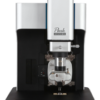
A microtome is a specialized precision cutting instrument, which accurately and repeatedly slices sections from a block of embedded tissue. Different kinds of microtomes are used to section paraffin and plastic embedded tissues (Figs. 4a–4c) as well as the specialized microtomes used to section frozen tissues (Fig. 4d). In any microtome a sharp knife and the tissue block are held in a fixed relation to each other. With each pass of the tissue past the knife it advances the tissue block a preset amount—the section thickness. For frozen sections the section thickness typically ranges from 8 to 15 µm, for wax sections 4–10 µm, and for plastic histological sections 0.5–3 µm. In electron microscopy sections must be extremely thin, about 200× thinner than wax sections. Typically plastic sections used in transmission electron microscopy (TEM) are cut in the range 60–100 nm (Figs. 7a and 7b).
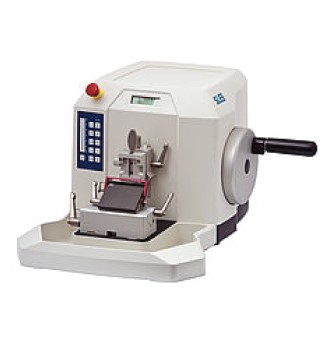
Microtome
A microtome is a mini-vice that holds a sample in place while a heavy and very sharp glass- or diamond-edged knife slices off sections of a few tens of microns thick
Be the first to review “Microtome”
Related products
High Vacuum AFM
Microscope
Microscope
Microscope
Atomic Force Microscope
Microscope
Reviews
There are no reviews yet.